 FlashFerry




What the timetables say
We counted as an overnight crossing every sailing that departs between 6pm and 3am and takes at least six hours — in other words, anything where you realistically sleep on board. That gives 1,178 sailings on 101 routes, a little over five per cent of everything in the archive. The pattern is unmistakable: almost half leave between 9pm and 11pm, and 10pm alone, with 263 sailings, is the single most popular departure time among European operators. A second cluster sits at 6pm to 8pm, mostly on the long Mediterranean and Adriatic runs where ships are still being loaded in the afternoon.
At the other end of the night the picture is just as clear. Two in three night ferries dock between 6am and 9am. Three in ten are in before 7am, one in ten before 6am. Operators set arrivals early on purpose, so lorry drivers and commuters can use the working day — the holidaymaker in the cabin is not the yardstick.
The ship often goes slower at night — on purpose
Put the day and night sailings of the same route side by side and a pattern emerges that surprises many people: the night ferry takes longer. Not because the ship is slower, but because the operator stretches the crossing. Nobody wants to arrive at 3am, so the ship runs at reduced speed or waits off the port for a while. For passengers that means more time in the bunk; for the operator, less fuel — both sides are happy.
| Route | Day sailing | Night sailing | Difference |
|---|---|---|---|
| Caen – Portsmouth (Brittany Ferries) | 6h (8:30am, 4:30pm) | 7h 45 (11:30pm → 6:15am) | almost two hours |
| Harwich – Hook of Holland (Stena) | 7h 15 (9:00am) | 8h (11:00pm → 8:00am) | 45 minutes |
| Tallinn – Helsinki (Tallink) | 2h (e.g. 7:30am) | 7h 35 (10:25pm → 6:00am) | nearly four times as long |
| Rostock – Trelleborg (Stena, TT-Line) | 6h (7:30am, 3:10pm) | 7h 10 (10:30pm → 5:40am) | a good hour |
| Heraklion – Piraeus (Minoan, Blue Star) | 7h 50 (8:00am) | 9h 40 (9:00pm → 6:40am) | almost two hours |
| Livorno – Olbia (Moby, Grimaldi) | 8h (10:00am) | 9h (10:00pm → 7:00am) | one hour |
| Stockholm – Turku (Viking, Tallink) | 11h (7:00am, 7:45am) | 10h 35 (8:00pm → 7:35am) | shorter at night |
On the Channel, Caen–Portsmouth is the textbook case: six hours in daylight, almost eight on the 11:30pm sailing, because Brittany Ferries wants you in Portsmouth at a quarter past six rather than half past four. The extreme example is Tallinn–Helsinki, where the day crossing takes two hours and the 10:25pm departure seven and a half — the operator is selling a hotel night that happens to end in the neighbouring country. The exception proves the rule: Stockholm–Turku is slightly shorter at night, because day and night ships call at different points in the Åland Islands, Mariehamn by day and Långnäs by night, with different lay-over times.
The sum the brochure leaves out
Depart 10pm, arrive 6am, so eight hours' sleep? That's not how it works. Subtract the time after casting off until you're in your cabin and the ship has settled. Subtract the time before arrival when you're woken, asked to clear the cabin and sent down to the car deck — on most ships that announcement comes well before the ropes go ashore. And subtract the time you don't sleep anyway because the surroundings are new. Realistically an eight-hour crossing yields five to six hours of sleep. On the short North Sea and Baltic overnights it gets tight.
| Route | Depart → arrive | Crossing | Realistic sleep |
|---|---|---|---|
| Plymouth – Roscoff | 10:00pm → 8:00am | 9h | 6 to 7h |
| Portsmouth – St Malo | 8:15pm → 8:15am | 11h | 7 to 8h |
| Le Havre – Portsmouth | 9:15pm → 7:00am | 10h 45 | 7h |
| Hull – Rotterdam | 8:00pm → 8:45am | 11h 45 | 7 to 8h |
| Harwich – Hook of Holland | 11:00pm → 8:00am | 8h | 5 to 6h |
| Aberdeen – Lerwick | 7:00pm → 7:30am | 12h 30 | 8h |
| Cherbourg – Dublin | 7:30pm → 2:30pm next day | 20h | a full night and a lazy morning |
The right-hand column is an estimate with one hour knocked off after departure and one hour before arrival — not a measurement, but a rule of thumb that holds up in practice. If you travel with children or sleep badly in strange beds, take another hour off. The Channel and North Sea overnights from Portsmouth, Hull and Aberdeen are among the more generous ones in Europe; Harwich–Hook of Holland is the one to watch: an 11pm departure and an 8am arrival sound like a full night, but the clock goes forward an hour on the way over.
Cabin, seat or reclining chair
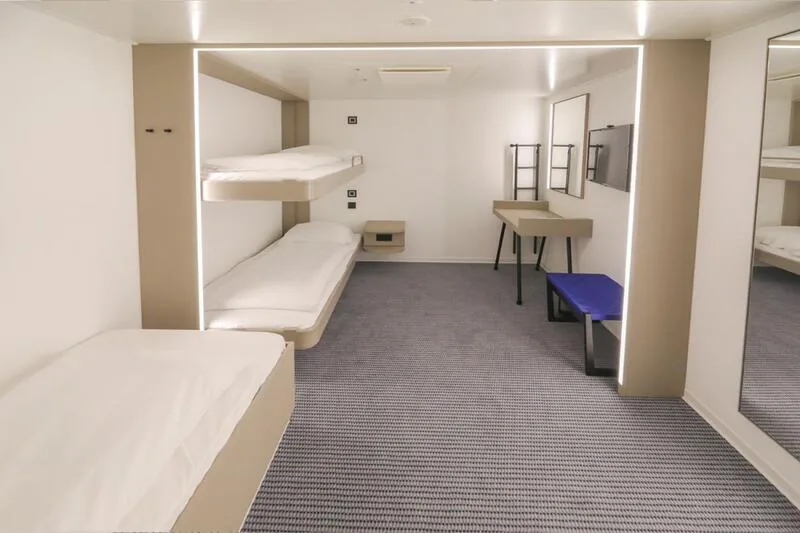
On roughly three in four overnight sailings in the archive a cabin is offered; on many night routes — including most Channel and North Sea overnights — it is compulsory, and the booking dialogue tells you so. Where it's optional, look at the crossing time. Under seven hours a cabin supplement is often hard to justify because you only lie down for a few hours anyway. From nine hours the cabin is almost always the better choice — not just for the bed, but for the door. Anyone who has tried to sleep in a reclining lounge next to a coach party knows why.
Inside or outside cabin matters less at night than by day: it's dark, and the window shows black water. What matters more is where the cabin sits. Cabins well forward feel the swell more; cabins directly above the vehicle deck hear the lorries being marshalled in the morning. The full trade-off is in our article on cabins versus seats.
The early arrival: blessing and curse
One in ten night ferries arrives before 6am. Barcelona–Palma docks at 5:30am, Rostock–Trelleborg at 5:40, Piraeus–Chios at 4:15, Karlskrona–Gdynia and Ystad–Świnoujście at 6am. For drivers with a long onward journey that's a gift: you roll off before the rush hour and have the whole day ahead. For everyone else it's a problem, because at half past five neither the hotel nor the harbour café is open.
Whether you may stay in your cabin after docking varies by operator — some lines plan for it and offer it at booking, others turn the ship round for the return sailing straight away. Ask before you book, not at check-in. And don't schedule your first appointment at the destination before 9am, even if the timetable promises 6.
Who the night ferry is right for
| Traveller | Night ferry? | Why |
|---|---|---|
| Driver with 200 miles or more still to go | Yes | A day gained; the early arrival suits the drive |
| Family with small children | Only with a cabin | Children sleep in a bed, not a chair; plan for an arrival before 7am |
| Motorhome or caravan | Yes | The vehicle deck is closed anyway; a night in the cabin beats a night on the pitch |
| Solo traveller without a car | Weigh it up | A cabin for one is expensive; a day sailing plus a cheap hotel is often equivalent |
| Short crossing under seven hours | Probably not | Too little sleep; a day sailing the day before with a night at the destination is more restful |
| Business trip with a morning meeting | Yes, with a buffer | Arrival is reliably early; still don't book the meeting before 9am |
How to plan an overnight crossing
| Step | What matters |
|---|---|
| Check the arrival time first | It decides sleep and onward travel more than the departure does |
| Compare crossing time with the day sailing | If the night is much longer, you get more sleep for the same money |
| Book a cabin from nine hours | Below that, check the reclining lounge if the supplement is steep |
| Choose the cabin position | Midships, not directly above the vehicle deck |
| Sort out breakfast and onward travel | Little is open at the destination before 7am |
| Ask about the wake-up call | On many ships the announcement comes an hour before arrival |
Frequently asked questions
How much sleep do you really get on a night ferry?
On an eight-hour crossing, realistically five to six hours: an hour is lost after departure, and an hour before arrival to the wake-up call and clearing the cabin. On Harwich–Hook of Holland with its eight-hour crossing that leaves five to six hours; on Portsmouth–St Malo with eleven hours, seven to eight.
Why does the night ferry take longer than the day ferry?
The operator stretches the crossing so that arrival falls at a usable hour. The ship runs slower or waits off the port. Caen–Portsmouth takes six hours by day and almost eight at night; Tallinn–Helsinki two hours by day and seven and a half at night.
Do I have to book a cabin on a night ferry?
On many overnight routes, yes — including most Channel and North Sea overnights — and the booking dialogue tells you. On roughly three in four night sailings in our archive a cabin is offered. Where it's optional, it's almost always worth it from about nine hours.
When do night ferries arrive?
Two in three between 6am and 9am. Three in ten before 7am, one in ten before 6am — Barcelona–Palma at 5:30am, for instance, or Rostock–Trelleborg at 5:40am. The Channel overnights into Portsmouth arrive between 6:15 and 8:15am.
Can I stay in the cabin after arrival?
That depends on the operator. Some lines offer it, others clear the ship for the return sailing immediately. Ask before booking, not on board.
Which night ferry gives the most sleep?
The one with the latest arrival for the latest possible departure. Aberdeen–Lerwick (7pm → 7:30am) and Hull–Rotterdam (8pm → 8:45am) give around twelve hours; Cherbourg–Dublin at twenty hours is a full night plus a morning at sea.
Timetables with departure and arrival times for every route are in the route search — the overnight sailings sit at the end of each day's list.
Choose a route